
History of Groundhog Day
Groundhog Day is here and if Punxsutawny Phil sees his shadow, this morning, there will be six more weeks of winter.
It’s hard to imagine in this day and age how people could give credit to a groundhog for forecasting the remainder of the winter. It is much easier to imagine if you put yourself back into the 18th and 19th centuries when people were mystified by how the weather worked.
Like today, weather also played a huge role in the day-to-day lives of early Americans. Farmers and businessmen alike relied heavily on the weather in nearly every aspect of their day.
Many people searched for signs and signals in nature to help them determine the weather in the coming days, weeks and months. This "weather lore" has often been proven accurate by science, but has been disproved an equal amount.
February 2 is the first cross-quarter day of the year, which is the halfway point between the winter solstice and the spring equinox in the Northern Hemisphere. This fits the holiday perfectly, since Phil predicts whether the second half of winter will be wintry, or more mild and spring-like. Cross-quarter days vary by year and region, but they occur in early May, early August and early November.
German settlers in Pennsylvania traditionalized Groundhog Day in the United States. These settlers brought a tradition stemming from Candlemas Day, where Europeans predicted if the sun shone on that day there would be a "second winter."
German settlers found a profusion of groundhogs in the state. They determined that the groundhog, resembling the European hedgehog, was a very intelligent animal. They therefore decided that if the sun did appear on February 2, such a wise animal as the groundhog would see its shadow and hurry back into its underground home for another six weeks of winter.
Across the U.S., there are several of these rodent prognosticators including the most famous one, Punxsutawney Phil from Pennsylvania. But some regions of the country have their own, like Buckeye Chuck from Ohio and General Beauregard Lee in Georgia.
By the way, if you’re keeping track of Phil’s forecasts, since 1887 he has seen his shadow 109 times. He has not seen it 21 times, and there were no Phil reports for various reasons for ten other years. The last time Phil did not see his shadow was in 2024, meaning he predicted that spring would be early.
Groundhog Day has links to many poems and beliefs about the coming season but it is based on no scientific fact. In the past 50 years or so, Groundhog Day has slowly become more of a fun celebration to break up the long winter than a forecast of things to come.
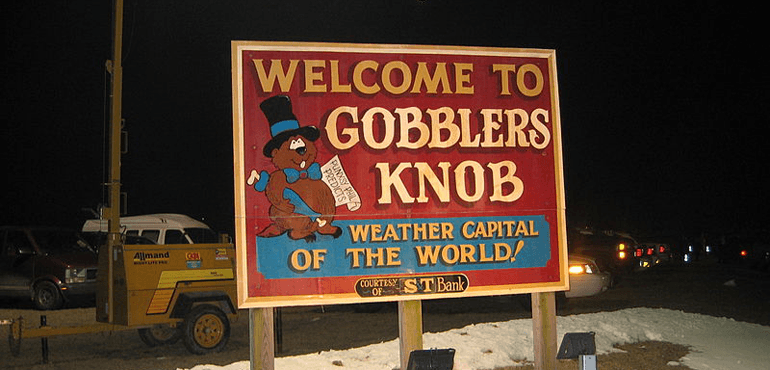
Image: The welcome sign for Gobbler's Knob on Groundhog Day 2005 in Punxsutawney, Pa. (Silvers Family, Wikimedia Commons)