Back to forecast
The Perfect Recipe For Maple Syrup: The Weather
March 17, 2026 at 03:15 AM EDT
By WeatherBug Sr. Meteorologist, Chad Merrill
Maple syrup is a great addition to warm pancakes and waffles but I bet you don't know how unique it really is. Let's take a look at how it was accidentally discovered and why it is only produced in a very small part of the world.
The roots of maple syrup production can be traced back before the 1800s. One legend says that Native American Chief Woksis, living near the Saint Lawrence Valley, hurled his tomahawk at a tree one early March night. He returned the next morning to remove it; he needed the tomahawk for his daily hunting adventure. Later that day, his wife saw in a bark vessel near the trunk of the same tree what appeared to be water, so she cooked it. The family loved the extra sweetness the resulting maple syrup produced in their dinner. From that day forward, maple syrup grew into a big business.
Maple syrup starts to run in March and April, although recent warming trends have allowed maple tapping to begin as early as January. Maple trees wake up after snow melts away from the base of the trunk. Sap comes up from the roots and provides nourishment to the buds. Don’t worry, tapping the syrup does not harm maple trees.
Sap is initially rich in sugar, but gathers more minerals from the tree as it continues to run. In the production process, sap is drawn back through pipelines to a storage tank or gathered by hand for later processing. The raw tree sap is then put through a process called reverse osmosis that takes some of the water from the sap. It is then boiled in an evaporator. Water in the sap evaporates and the sap thickens. After the temperature reaches 219 degrees Fahrenheit, the sap becomes syrup. The syrup is then filtered while it’s still hot and adjusted for density and graded for flavor.
Believe it or not, up to 60 gallons of sap are needed to produce one gallon of store-ready syrup. Since one maple tree typically produces 10 to 20 gallons of sap, it takes up to three maple trees to produce one gallon of store-ready syrup!
The length of time maple syrup flows from the tree is dependent on the weather. The ideal spring weather pattern to produce the most syrup is for night temperatures to drop into the 20s and daytime highs in the 40s under sunny skies. This freezing and thawing cycle builds up pressure within the tree and allows sap to flow more readily. Warmer- than- average temperatures end the season early.
The Great Lakes and New England are the source for syrup each year in the U.S. Only 2 million gallons of maple syrup was produced in 2010. The United States Department of Agriculture Statistics Service indicates production in 2019 reached 4.24 million gallons. The reason for increased sap production is technology development taking the place of traditional bucket collection. This has allowed more trees to be tapped than ever before.
Quebec, Ontario, New Brunswick and Nova Scotia, Canada, are the only other places maple syrup is produced. The necessary climate to produce maple syrup is not found anywhere else in the world, believe it or not!
Most folks use syrup sparingly because of its rich taste, so should you be concerned about its shelf life? Experts say pure maple syrup will keep for a year if refrigerated and can be kept fresh forever in a freezer, since it won’t solidify in that environment.
Don’t take for it for granted though! Remember the unique history behind this blissfully sweet commodity, the perfect weather needed to produce the sweet sensation and how many maple trees were tapped to make your pancake taste extra special!
---
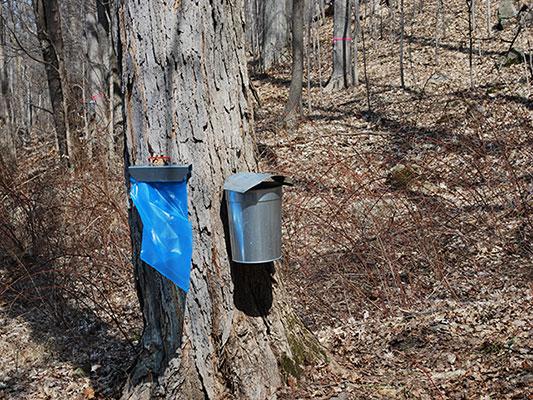
Story Image: Maple sap collecting at Bowdoin Park in Dutchess County, N.Y. (Courtesy of Wikimedia Commons)
The roots of maple syrup production can be traced back before the 1800s. One legend says that Native American Chief Woksis, living near the Saint Lawrence Valley, hurled his tomahawk at a tree one early March night. He returned the next morning to remove it; he needed the tomahawk for his daily hunting adventure. Later that day, his wife saw in a bark vessel near the trunk of the same tree what appeared to be water, so she cooked it. The family loved the extra sweetness the resulting maple syrup produced in their dinner. From that day forward, maple syrup grew into a big business.
Maple syrup starts to run in March and April, although recent warming trends have allowed maple tapping to begin as early as January. Maple trees wake up after snow melts away from the base of the trunk. Sap comes up from the roots and provides nourishment to the buds. Don’t worry, tapping the syrup does not harm maple trees.
Sap is initially rich in sugar, but gathers more minerals from the tree as it continues to run. In the production process, sap is drawn back through pipelines to a storage tank or gathered by hand for later processing. The raw tree sap is then put through a process called reverse osmosis that takes some of the water from the sap. It is then boiled in an evaporator. Water in the sap evaporates and the sap thickens. After the temperature reaches 219 degrees Fahrenheit, the sap becomes syrup. The syrup is then filtered while it’s still hot and adjusted for density and graded for flavor.
Believe it or not, up to 60 gallons of sap are needed to produce one gallon of store-ready syrup. Since one maple tree typically produces 10 to 20 gallons of sap, it takes up to three maple trees to produce one gallon of store-ready syrup!
The length of time maple syrup flows from the tree is dependent on the weather. The ideal spring weather pattern to produce the most syrup is for night temperatures to drop into the 20s and daytime highs in the 40s under sunny skies. This freezing and thawing cycle builds up pressure within the tree and allows sap to flow more readily. Warmer- than- average temperatures end the season early.
The Great Lakes and New England are the source for syrup each year in the U.S. Only 2 million gallons of maple syrup was produced in 2010. The United States Department of Agriculture Statistics Service indicates production in 2019 reached 4.24 million gallons. The reason for increased sap production is technology development taking the place of traditional bucket collection. This has allowed more trees to be tapped than ever before.
Quebec, Ontario, New Brunswick and Nova Scotia, Canada, are the only other places maple syrup is produced. The necessary climate to produce maple syrup is not found anywhere else in the world, believe it or not!
Most folks use syrup sparingly because of its rich taste, so should you be concerned about its shelf life? Experts say pure maple syrup will keep for a year if refrigerated and can be kept fresh forever in a freezer, since it won’t solidify in that environment.
Don’t take for it for granted though! Remember the unique history behind this blissfully sweet commodity, the perfect weather needed to produce the sweet sensation and how many maple trees were tapped to make your pancake taste extra special!
---
Story Image: Maple sap collecting at Bowdoin Park in Dutchess County, N.Y. (Courtesy of Wikimedia Commons)