Today's Weather Outlook

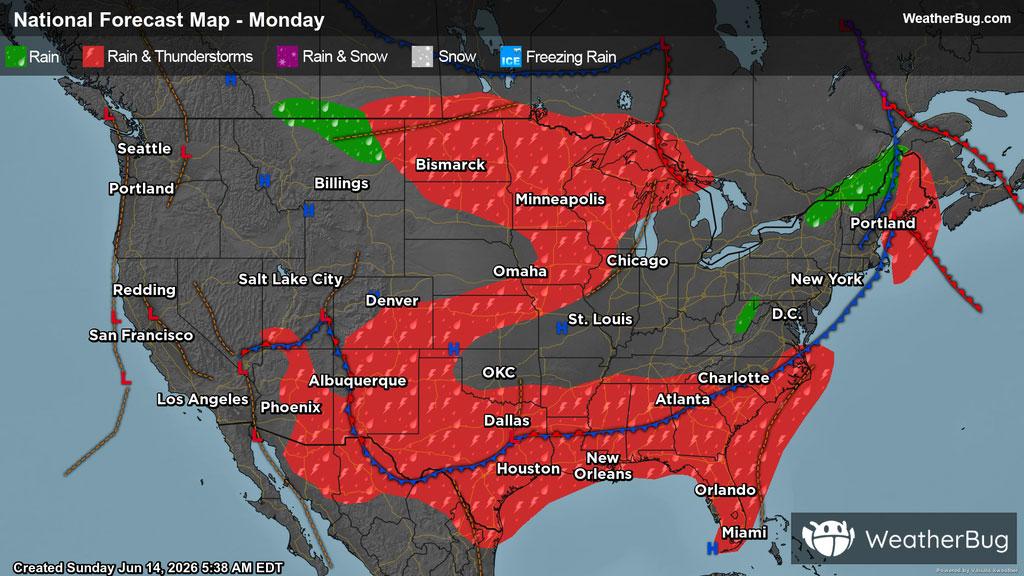
A thorough mix of precipitation is impacting the nation today. Mother Nature releases her wrath with several areas seeing a wet, wintry mix of precipitation.
In the Northeast, wet wintry weather is creating an inconvenient mix of precipitation with snow, ice, rain, and thunderstorms. While a large majority of the Northeast will remain dry, the northern Appalachians will see snow, and the western halves of New York and Pennsylvania will see a wintry mix. Parts of New York and Pennsylvania should expect a rain and snow mix, accompanied by patchy, very light icing.
Most of the Mid-Atlantic into the Southeast will be dry, with high pressure dominating and prohibiting precipitation from dropping in. Also keeping dry will be the Deep South and Southern Plains.
A portion of the Central Plains over Nebraska and Kansas will remain dry as well, though the rest of the Upper Midwest will not be as lucky. A wintry mix will spread along the northern halves of the northern Midwestern states this afternoon onward, and the southern half of the Great Lakes region may see isolated thunderstorms accompanying its evening showers. The Northern Plains should expect a rain and snow mix as well, with the possibility for light icing in areas that cold air often pools.
The Mountain West should expect to see a plentiful topping of snow on the Rockies, with a wintry mix falling upon the foothills into the lowland areas. Lowland valleys should expect more of a cold rain overall. While some snowflakes are sure to fall, they are likely not to stick to the ground below the mid-elevations.
Hopefully the Desert Southwest enjoyed dry weather this weekend, because wet weather is not forecasted to end soon. Rain and snow-mixed conditions will continue to impact the area, as well as more impactfully along the West Coast. Snow will stick to higher mountainous peaks throughout the Desert Southwest and Great Basin Desert, but a mix is expected to fall in the foothills, leading to cold rain in the valleys.
The Pacific Northwest continues to see a surge of moisture into the area, with snow falling atop the snow-droughted Cascades, and a rain/snow mix falling into the foothills, leading to cold rain in the valleys.
Sub-freezing temperatures will not be common, as the only areas forecasted to see temperatures in the 20s and below are the higher mountainous peaks of the Sierra Nevada, Cascades, and Rockies.
However, 30s are in fact in store for New England, the northern Great Lakes, the Northern Plains along the U.S.-Canada border, and the foothills of the Rockies, Sierra Nevada, and Cascades.
Temperatures in the 40s and 50s are more frequent in previously frigid areas, including the northern Mid-Atlantic, southern Great Lakes region, northern Plains, lowland valleys within the Rockies and Cascades, and California’s Central Valley.
Areas seeing temperatures in the 60s are the Mid-Atlantic, Central Gulf Coast, the Tennessee Valley, and the Desert Southwest.
A surge of heat will be seen through the Plains, as 70s will extend into the Central and Southern Plains. These temperatures will also be found in eastern Texas and northern Florida.
States really heating up are Texas and southern Florida, which will see temperatures up into the mid-80s!