2025 Year in Review: Billion-Dollar Disasters From May through June

Between May and June this past year, six separate billion-dollar disasters, all related to severe weather, struck the United States. In total, they claimed 39 lives alongside an estimated US$16.8 billion in damages.
These months are a transitional time for the weather in the U.S. Wintry weather pulls back toward the north as warm spring moisture streams northward. This cold air aloft, in combination with warm air near the surface, helps create the conditions needed for impactful severe weather.
May 1-3, 2025: Eastern Severe Storms
Through May’s three opening days, one life was lost, and US$1.9 billion in damages was recorded as a strong frontal system moved through the Central to Eastern U.S., firing off numerous severe storms all the way from Texas to Massachusetts. On May 1st, a few rotating storms produced tornadoes in Texas and Oklahoma, including a high-end EF1 in Burnet County, Texas, that damaged 5 homes and injured one. A gusty squall line moved through northeastern Ohio and western Pennsylvania, knocking down trees in the towns around Pittsburgh and Cleveland.
The storms’ focus shifted east alongside numerous severe gusts and hailstorms by May 2nd. Kentucky, Tennessee, northern Mississippi, northern Alabama, and northern Georgia saw the bulk of severe activity, and hail diameters exceeding 2 inches were recorded in Franklin County, Ala.! The frontal system continued to push the storms eastward into the Southeast, Mid-Atlantic, and coastal Northeast on May 3rd. Wind reports dominated the day, with a few EF1 tornadoes in Alabama, including Talbot, Jackson, and Dekalb counties.
May 15-17, 2025: North Central and Eastern Severe Storms
Large hail, more than 60 tornadoes, and widespread damaging winds resulted in the year’s second most costly severe weather outbreak in mid-May, totaling US$5.9 billion in damages. A deep low-pressure system in the northern Plains and Upper Midwest enabled strong severe storms beginning May 15th. Sufficiently strong winds jetted under swirling winds aloft to produce tornadic storms in Minnesota, Wisconsin, and Michigan’s Lower Peninsula through the first day. Large hail and damaging wind gust reports followed wherever these storms traveled.
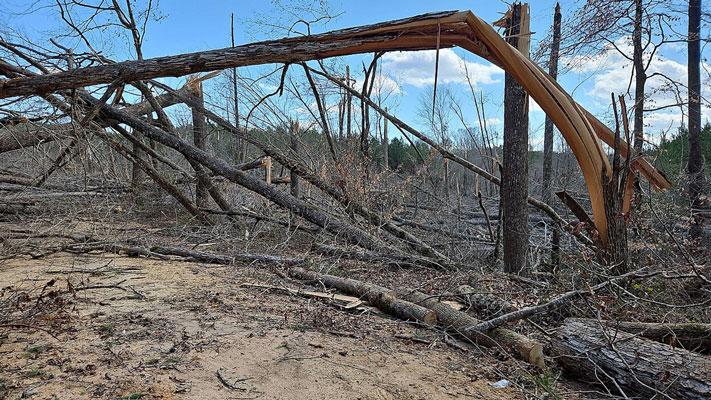
On May 16th, the Storm Prediction Center issued an alerting 4 out of 5 Moderate convective risk for the Lower Midwest, Ohio Valley, and northern Tennessee Valley. Several deadly tornadic storms tracked across the risk area that afternoon and night, including many damaging windstorms. Next to St. Louis, an EF3 tornado tracked across a city suburb, leaving five fatalities. A long-tracked EF4 tornado in south-central Kentucky traveled over 60 miles, injuring over 100 people and claiming 19 lives, with its parent supercell surviving from southeastern Missouri to the Kentucky-Virginia border. Damaging windstorms arrived in the interior of the Northeast for New York, Vermont, and New Hampshire on May 17th. Further southwest, a few rotating storms were observed in the Mid-South and Southern Plains, creating deep impacts with large hail and damaging winds before finally exiting the nation.
May 18-20, 2025: Central and Southeastern U.S. Tornado Outbreak
As a big-time system exited the East Coast, leaving behind tornadoes, severe gusts, and hail, another system entered the Plains on May 18th. With fierce winds aloft overspreading a moist southern airmass, the stage was set for impressive rotating storms across eastern Colorado, southern Nebraska, Kansas, western Oklahoma, and central to northern Texas. According to the National Weather Service and Storm Prediction Center, over 60 tornado reports and 170 hail reports were filed. Late into the night, a lone tornadic storm traveled from Greensburg to Plevna, Kansas, producing five EF3 tornadoes along its path!
On May 19th, this system shifted eastward to the eastern Plains, Mid-South, and Lower Midwest, with a larger Moderate Risk issued by the National Weather Service. Numerous wind and hail observations were reported in eastern Kansas, eastern Oklahoma, and western Missouri. While no strong tornadoes occurred, rotating thunderstorms produced tornadoes in eastern Missouri, eastern Oklahoma, and western to central Arkansas. May 20th shifted severe activity southeastward to the Mid-South, Tennessee Valley, and Lower Ohio Valley. Tennessee and northern portions of Mississippi, Alabama, and Georgia felt the strong, damaging winds from these storms. All in all, this severe outbreak created US$2.6 billion in losses!
May 22-26, 2025: Southern Severe Storms
Five days of large hail, damaging winds, and tornadoes began on May 22nd. The first of many upper-level disturbances shifted off the southern Rockies and over the southern Plains as a northern cold front and southern warm front converged. Alongside this unstable confrontation, a moisture surge drew up from the Gulf, giving the system the ingredients for a prolonged period of severe weather. Up to baseball-sized hail struck the central alleys of northern Texas and Oklahoma the first day, while severe gusts clustered in central Texas. Activity nudged northward on May 23rd. Notably, up to teacup-sized hail and uprooted trees were reported from central Oklahoma through the Nebraska Panhandle, and multiple brief tornadoes were observed in Colorado’s Palmer Divide.
Activity also moved into Dixie Alley on May 24th. Several severe gusts and hailstorms formed across two regions: the Lower Mississippi River Basin into southwestern Alabama within a severe thunderstorm cluster, and along a severe thunderstorm line pushing from western Texas into southern Kansas. The unstable stationary front did not budge on May 25th, as severe wind gusts straddled from New Mexico through western Georgia. Multiple EF-U (Unknown) to EF1-rated twisters clustered in both the southern Texas Panhandle and southwestern Appalachia, while the largest hail fell between central Texas and western Oklahoma. The last, and certainly not weakest, severe weather batch from the outbreak propagated on May 26th, as the stalled front pushed southward nearer the Gulf. Numerous large hail reports, with hail diameters exceeding 5 inches in one observation, fell over New Mexico and Texas! A few EF-U (Unknown) to EF1 tornadoes and widespread across severe gusts charged from New Mexico through Georgia, with one 90 mph gust reported in Louisiana. Just above US$1.2 billion in damages were marked over this five-day span, and fortunately, no casualties occurred.
June 5-7, 2025: Southeastern and Central Severe Storms
A line of thunderstorms across the Texas Panhandle initiated early in the morning on June 5th, and even then, the atmosphere was unstable enough to turn them severe, mixing with upper-level energy. Isolated damaging wind gusts, hail, and a few tornadoes propagated into eastern Oklahoma’s border by nightfall as the line intensified. However, a separate afternoon supercell spawning in New Mexico went on to form eight tornadoes, crossing the border into Texas. Luckily, the supercell withheld tornadoes as it neared Lubbock, Texas, but not before three EF-2s dug up the earth. Parts of Lubbock still observed up to tennis ball-sized hail from that same supercell.
By June 6th, upper-level energy and unstable surface air would begin to stretch in tandem from the southern Rockies to New England. Mainly severe wind gusts surged from the Tennessee Valley into the southern Mid-Atlantic and separately in central New England. Most large hail and tornado encounters appeared in the south-central U.S. between Texas and Oklahoma, where conditions favored supercells. Overall, damages were widely scattered but far-reaching that Friday. More organized severe storm clusters regrouped on June 7th under the upper-level disturbance and a weak front, which shifted over Arkansas through South Carolina. Although few instances of large hail or tornadoes were documented, mainly in Missouri, severe thunderstorms expelled numerous severe wind gusts through the Deep South’s interior, leaving thousands of downed power lines and trees in their wake. In total, this destructive weather period accrued US$2.4 billion in damages, with seven lives lost.
June 15-19, 2025: North-Central and Northeast Severe Storms
Late in the severe storm season, rich Gulf moisture mixed with an upper-level disturbance shifting overhead from over the Rockies ignited scattered severe thunderstorms in the northern High Plains. June 15th marked the beginning of another five-day severe weather entourage, with damaging winds and large hail from eastern Montana into Nebraska’s Panhandle. At the surface, a cold front slowly took form, removing the highly unstable atmosphere’s cap over the central Plains and the Upper Midwest. Through June 16th, damaging winds realigned as storms combined in the central Plains as gusts hit 55 to 70 mph, clustering from south-central Kansas into eastern Iowa. Many storms containing nickel to golf ball-sized hail and tornadoes spun up in the Midwest on day two, with several EF-U (Unknown) to EF-1 tornadoes confirmed between Colorado, Nebraska, and primarily, Minnesota.
The cold front and the previous thunderstorms’ outflow advanced south-southeastward, deeper into the central Plains, as another upper disturbance shifted in from the Four Corners on June 17th. Similar impacts to Tuesday erupted along the Colorado High Plains, southern Kansas, and northern Oklahoma. Up to 70 mph severe wind gusts, up to golf ball-sized hail, and several other EF-U (Unknown) to EF-1 tornadoes were reported. Multiple severe gusts also struck the southern Appalachian Piedmont ahead of another disturbance. By June 18th, a low-pressure area formed in the Upper Midwest as storms strengthened, and the cold front launched both thunderstorm clusters and lines in a quick shift northeastward. From this development, severe weather amplified. Corn fields, trees, and power lines toppled in the Lower Midwest, and specifically Illinois, under stressful severe wind gusts.
Although hail reports waned, June 18th observed the event’s most twisters, including an EF-2 tornado in Jacksonville, Ill. This five-day outbreak concluded after June 19th as damages turned to the East Coast ahead of the fully-fledged storm system. The cold front intensified during the ensuing severe squall, with wide-reaching, damaging gusts buffeting the Mid-Atlantic before exiting that night. Following seven casualties, as well as widespread agricultural, electrical grid, and home damages, the five-day outbreak resulted in US$2.8 billion in damages, mainly from damaging gusts.
Six separate billion-dollar disasters is an above-average number when compared to previous years in May and June, with just a 10% chance to occur leading into 2025 based on past climatological data.
Sources: Climate Central, National Weather Service, Storm Prediction Center
---
Image courtesy of Gateway Arch Foundation West CCTV via Wikipedia Commons