Weekend Weather Outlook
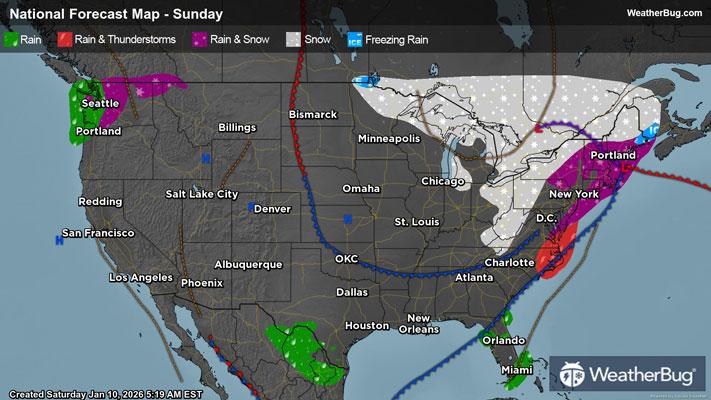
The eastern half of the nation will face wet, wintry precipitation through the weekend as low pressure plagues weekend plans.
Sunday
As a low pressure system makes its way across the eastern half of the Nation, East Coast states will continue to be plagued with wintry weather over the remainder of the weekend.
In the Northeast, low pressure will continue to bring snow to states along the U.S.-Canada border and Great Lakes. This snowfall will hug the northern portions of these states, while areas along the Northeast coast will see a rain/snow mix. It is possible that lower elevated areas will just see a cold rain. The mix of precipitation can cause icy conditions, mainly in the northern coast of Maine. Rain showers and isolated thunderstorms will extend along the East Coast along Virginia and North Carolina coasts.
In the Southeast, conditions will be clear, with Florida finally receiving rainfall from the passing of this low-pressure system. Isolated thunderstorms are possible to accompany these rainy conditions. The Deep South will see a similar trend of dry weather, with southwestern Texas being the only area to see some rain showers.
The Midwest will see conditions like today, with snowfall expected in states around the Great Lakes. Weather conditions will be primarily dry for the remainder of the Midwest.
The Mountain West will see clear conditions too, with dry weather persisting throughout the rest of the weekend.
The West Coast will see dry conditions everywhere but the Pacific Northwest. The Pacific Northwest will have continued rainy conditions down the Oregon coast, with a rain/snow mix clinging to the Cascades. Snow will fall atop the higher mountainous peaks within the Cascades, with a mix of rain and snow leading into cold rain in the valleys.
Temperature trends will remain similar for the country on Sunday as they were today, with below-freezing temperatures in the teens clinging to Minnesota, North Dakota, and South Dakota.
Temperatures will be in the 20s among the Midwest surrounding the Great Lakes, the U.S.-Canada border in Maine, and the higher elevations in the Rockies.
High 30s and low 40s can be expected for the much of the Northeast, with exception to coastal areas. These temperatures will extend through the Tennessee Valley into the Central Plains. The lowland areas of the Mountain West will also see temperatures in this range. Lastly, the Pacific Northwest will see temperatures in the high 30s and low 40s.
Areas that will see temperatures in the high 40s and low 50s will be the Northeast Coast and Mid-Atlantic states, except for their coasts. These temperatures will extend through the Gulf Coast and the northern portion of Texas. California's Central Valley will also see these temperatures.
60-degree temperatures will be seen along the Mid-Atlantic coast through northern Florida. The Rio Grande Valley and Desert Southwest will also see these temperatures.
Lastly, southern Florida will have the highest temperatures across the country, with temperatures in the mid-70s and low 80s.